
4 Easy Steps to Select Your Digital Torque Wrench
<〈Please drop down to check the product item.〉>
If the torque is known, you can proceed directly to Step 4: Selecting a Wrench

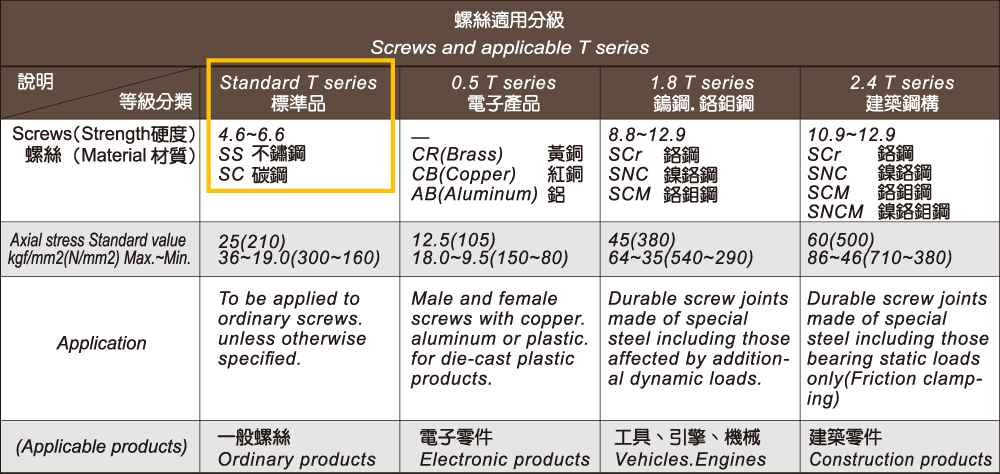
1. Screw Grade
※For stainless steel screws, classified as standard "T" grade, like the yellow frame.
2. Thread Width


3. Confirming Torque
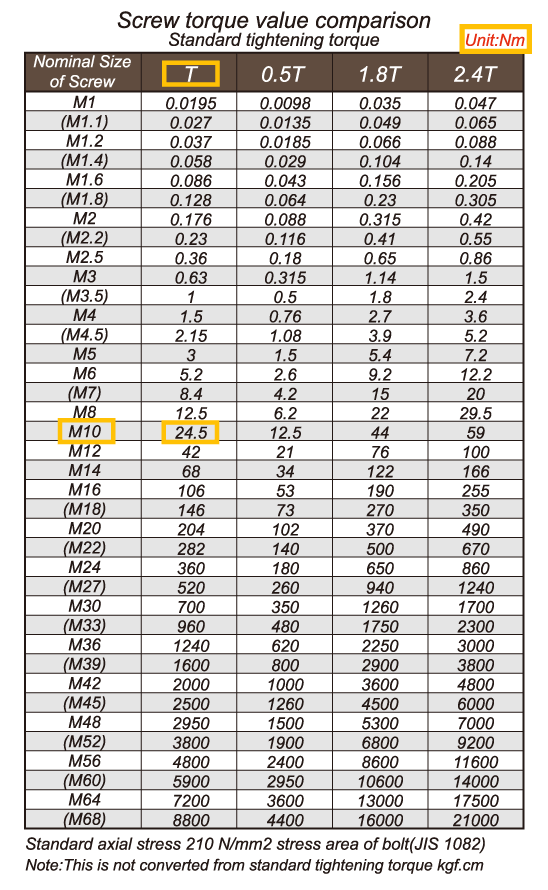
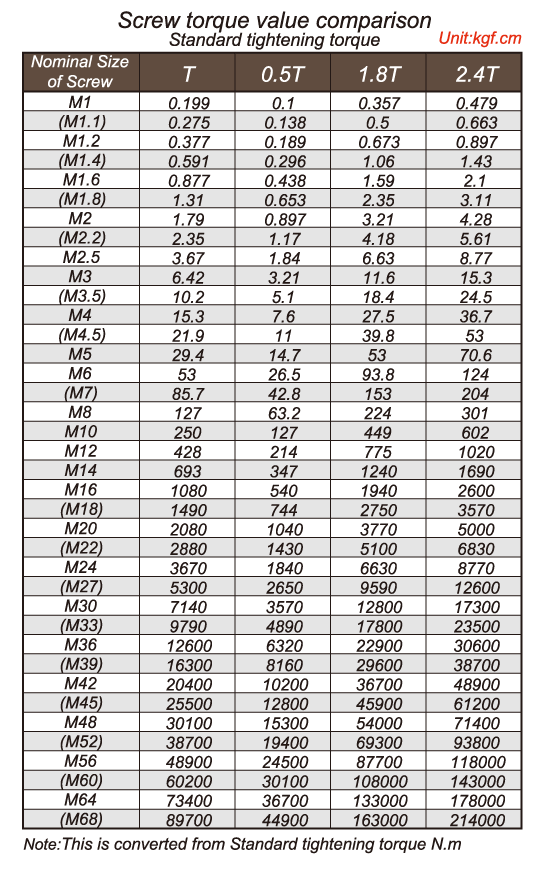
※ 1 Nm = 10.2 kgf-cm = 0.738 lbf-ft = 8.851 lbf-in
Note 1. Friction Variation and Deviations: The torque values in this table are calculated based on a Target Axial Stress of 210 N/mm² and a Torque Coefficient (K-factor) of 0.2 (Slightly Oiled). In practical applications, the K-factor may fluctuate between 0.12 and 0.25 depending on surface treatments and lubrication. This means that at the same torque setting, the deviation in actual axial tension can exceed 50%. In other words, a surface that is too lubricated (slippery) may lead to bolt breakage, while a surface that is too dry may result in insufficient clamping force. It is strongly recommended to maintain consistent lubrication or perform site-specific testing.
Note 2. Stainless Steel Fasteners (SUS304 / SUS316): Due to high ductility and superior surface friction characteristics, stainless steel fasteners are highly susceptible to "Galling" or "Cold Welding" during the tightening process. It is highly recommended to apply an appropriate Anti-Seize lubricant to stabilize friction and prevent thread damage. If no lubricant is applied, it is advised to lower the target torque to the 0.8T series or below to ensure safety.
Note 3. Hierarchy of Specifications: This table is compiled based on the effective stress area defined in JIS B 1082 and the tightening principles of JIS B 1083. Should specific industries (e.g., Automotive, Aerospace, Marine, Precision Machine Tools) provide dedicated service manuals with recommended torque or angle values, those manufacturer specifications must take absolute precedence.
Note 4. Fastening Method Recommendations: This table is based on the "Torque Control Method." Since torque is an indirect measure of axial tension, it is highly sensitive to friction variables. For high-reliability or high-precision requirements (such as structural joints or safety-critical components), it is recommended to implement the "Torque + Angle Control Method" or "Direct Tension Measurement" to minimize the risk of inconsistent fastening quality caused by friction variance.
4. Selecting a Wrench
Screw head |
Tool |
Wrench |
|
|
|
|
.png) .png) |
.png) External Hex Socket .png) Internal Hex Socket |
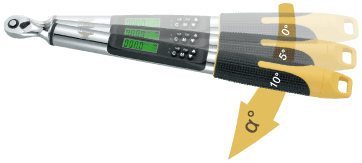
WA-E - Electric, Digital, Angle, Sound and Vibration, WiFi, BlueTooth 13.5~135Nm |
|
|
|
WD-I - Interchangeable, Mechanical, Electronic, Slip Warning, BlueTooth 5~200Nm
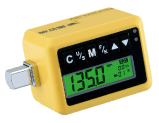
WM-I - Interchangeable, Digital, Sound and Vibration, (BlueTooth) 0.9~25Nm
|
.png)
.png)




-MIN.png)

.png)
.png)



★Example: If the screw head is
 , the screw is [M10 + T grade], and the corresponding torque is [24.5 Nm], the wrench model to choose would be
1. WI-135-2 Suggested Torque Range 20~135 Nm
2. WD-I30-1 Torque Range 5~30 Nm
3. WD-I100-2 Torque Range 15~100 Nm