
Quick Navigation
[ 1 ] What Are Leveling Feet?
Leveling Feet / Mounts are also commonly known as adjustable feet, anti-vibration mounts, machine feet, bases, or support posts. They are essential support and adjustment components installed beneath machinery, industrial frames, and work platforms. Their primary functions are to support equipment weight, compensate for uneven floors, and precisely adjust the machine's level and height through a threaded mechanism. In industrial production and automation, leveling feet serve as an important interface between the equipment and the floor, helping provide stable support while absorbing differences between the machine and the ground.
Why Are Precision Equipment More Sensitive to Base Support?
Precision equipment often includes high-speed motors, precision linear guides, and sensitive components, making stable base support especially important. This is why leveling feet for automation equipment and precision machinery require careful selection. In the industry, they may also be referred to as machine feet, adjustable feet, or leveling feet. The key difference is whether they provide angular compensation and whether an anti-vibration pad is included, as in articulating anti-vibration leveling feet.
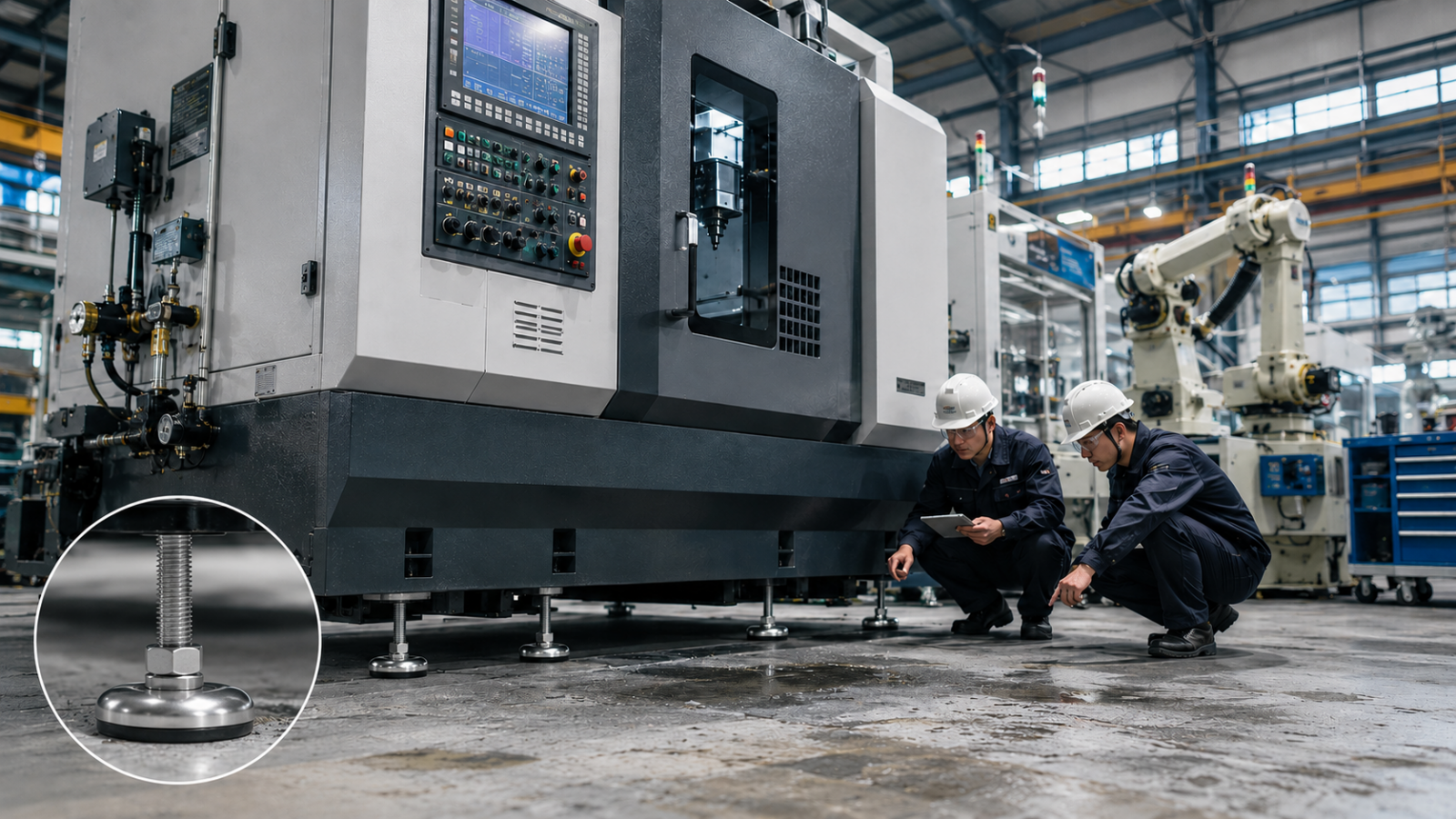
▲ Illustration of leveling feet in use, AI-generated
[ 2 ] 4 Problems Solved by Articulating Leveling Feet
One of the most common comments we hear from engineers is: "The equipment has already been leveled, but it still shakes during high-speed operation." One possible cause is incomplete contact between the bottom of the leveling foot and the floor. When conventional fixed leveling feet are installed on an uneven surface, they can create concentrated point loading, which may lead to a series of equipment problems. Here's how Articulating Leveling Feet can help address four common issues:
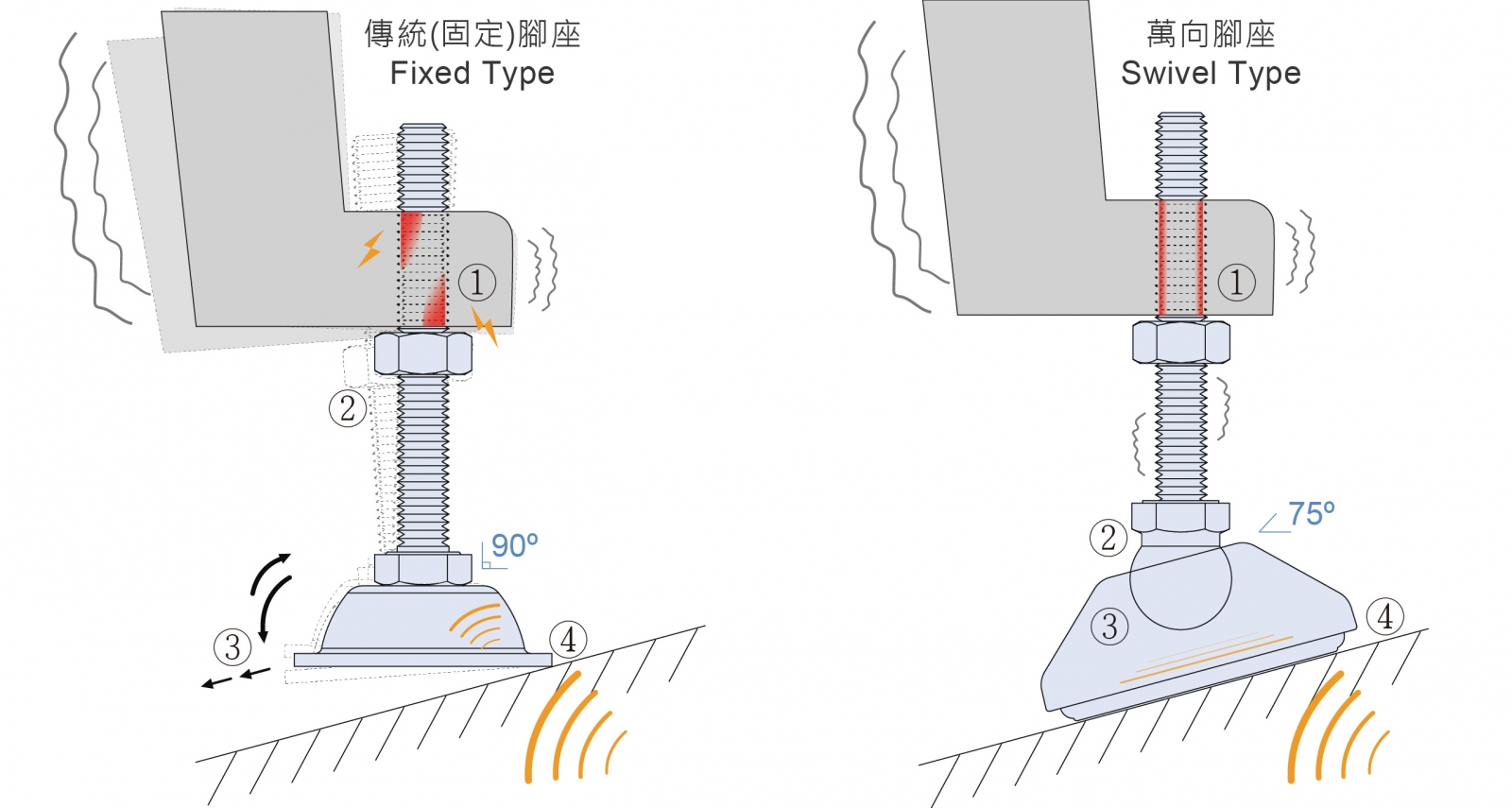
▲ Articulating function illustration
1. Vibration and Oscillation
- Problem: Incomplete contact between the leveling foot and the floor can allow small vibrations from the operating equipment to trigger resonance.
- How Articulating Leveling Feet Help: The threaded stud can adjust its angle, while the arc or ball-head design at the bottom allows the foot to conform to the slope of the floor. Combined with a CR synthetic rubber or NBR (nitrile rubber) anti-vibration pad, the leveling foot can absorb impact, reduce resonance, and significantly reduce operating noise.
2. Threaded Stud Bending and Fracture
- Problem: An uneven floor can cause the contact angle to shift. Under heavy loads, the threaded stud is subjected to lateral forces rather than purely axial loading, which may lead to fatigue failure over time.
- How Articulating Leveling Feet Help: Asmith Articulating Leveling Feet provide 4° to 15° of angular adjustment, helping redirect lateral forces into a more evenly distributed vertical load and extending threaded stud service life.
3. Machine Movement After Installation
- Problem: Insufficient contact area between the leveling foot and the floor can reduce friction, allowing the machine to gradually shift during high-speed movement or vibration.
- How Articulating Leveling Feet Help: By maintaining better contact with the floor and combining high-grip CR synthetic rubber or NBR pads, the equipment can remain more stable even on automation lines with frequent start-stop cycles.
4. Base Deformation and Loose Components
- Problem: Long-term point loading can concentrate stress on the equipment base. Over time, this may reduce flatness and potentially cause structural distortion or loosened components.
- How Articulating Leveling Feet Help: More evenly distributed loading helps reduce structural deformation, maintain the accuracy of machining and measurement, and extend overall equipment service life.
[ 3 ] How to Choose Articulating Leveling Feet?
A 3-Second Selection Guide
-
Check the Load Capacity: Threaded Stud Diameter Directly Affects Load Capacity
```- Up to 900 kgf (light to medium duty): Choose the DK(S)-10, DK(S)-08, DK(S)-04, or DK(S)-05 series.
- 1,000 kgf and above (heavy-duty / high-vibration applications): Choose the DK-09 or DK-07 series.
-
Recommended Load:
All Asmith leveling feet are evaluated through destructive load testing to determine recommended load capacities, helping ensure stable support and reduce the risk of instability even when equipment weight is unevenly distributed.
-
Consider the Floor Condition and Anchoring Requirements
-
⚠️ Important
- ```
SPECIFICATIONS
| Comparison | DK(S)-10 | DK(S)-08 | DK(S)-04 | DK(S)-05 |
|---|---|---|---|---|
| Product Image | -10.png) |
-08.png) |
-04.png) |
-05.png) |
| Product Positioning | Classic Series | Anti-Vibration Series | Large-Angle Anti-Vibration Series | Floor-Anchoring Series |
| Max. Recommended Load | ~900 kgf | ~800 kgf | ||
| Articulation Angle | 4° | 15° | ||
| Articulating Mechanism | Patented Arc Design | Ball-Head Type | ||
| Anti-Vibration | — | Yes (NBR) | ||
| Floor Anchoring | — | Yes (Expansion Anchor) | ||
| Base Plate Material | DK Series: Zinc-Plated SCM DS Series: SUS304 |
DK Series: (PA66 + GF) DS Series: SUS304 |
||
| Threaded Stud Material | DK Series: Zinc-Plated SCM DS Series: SUS304 |
|||
| Heat Resistance | — | 130°C | ||
| Flammability Rating | — | UL94 HB | ||
| Humidity Range | No Special Restrictions | 40–60% (Not Recommended for Dry Rooms) | ||
| Recommended Applications | General Precision Machinery, Automation Equipment, General Industrial Frames |
CNC Machining, High-Vibration Equipment, Equipment Prone to Movement |
Highly Uneven Floors, Light- to Medium-Duty Automation Equipment |
Highly Uneven Floors where Floor Anchoring Is Required to Prevent Tipping |
How to Choose Leveling Feet for Large Machinery: The Right Solution for Heavy-Duty Equipment
Standard Articulating Leveling Feet are commonly used for automation equipment and light- to medium-duty industrial frames. When equipment weighs more than 1,000 kgf, such as gantry milling machines, injection molding machines, pressing machines, or large inspection equipment, conventional threaded leveling feet can approach their load and structural fatigue limits. For these applications, we recommend Asmith's heavy-duty adjustable anti-vibration leveling feet, the DK-07 / DK-09 series:
| Comparison | DK-09 | DK-07 |
|---|---|---|
| Product Image | 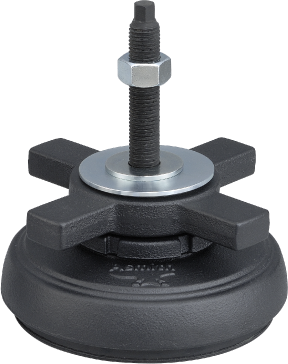 |
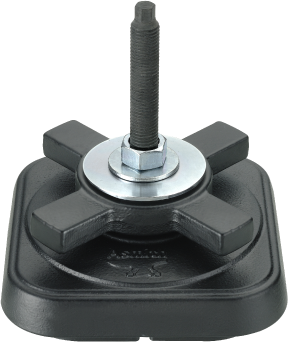 |
| Product Positioning | Heavy-Duty Vibration-Resistant |
Ultra-Heavy-Duty Premium |
| Max. Recommended Load | 1,300 kgf | 1,700 kgf |
| Articulation Angle | 4° | |
| Articulating Mechanism | Base Plate Washer | |
| Anti-Vibration | Yes (CR Synthetic Rubber) | |
| Floor Anchoring | No | |
| Base Plate Material | FC-250 Cast Iron (Powder Coated) |
|
| Threaded Stud Material | S45C Heat-Treated and Manganese-Phosphate Coated | |
| Heat Resistance | — | |
| Flammability Rating | UL94 V0 (Highest Rating) | |
| Humidity Range | No Special Restrictions | |
| Installation | Drill a through hole only. Do not tap the hole. | |
| Recommended Applications | Robot Bases, Injection Molding Machines, Large Packaging Machines, Stamping Presses |
Gantry Milling Machines, Large Hot-Press Molding Machines, Heavy-Duty Automation Equipment |
DK-07 / DK-09 Heavy-Duty Adjustable Anti-Vibration Leveling Feet can support an exceptionally high load of 1,300–1,700 kgf per foot. Compared with conventional leveling feet, their key advantages include:
1. Separate Load-Bearing and Articulating Functions for Maximum Load Capacity
Heavy load capacity and height adjustment: The equipment load is supported directly by the adjustable base plate, preventing excessive load concentration on the threaded stud that could lead to fatigue failure. This design is also what allows height adjustment while the equipment remains under load.
Articulation: The 4° articulating function is independently positioned outside the leveling foot and allows fine angular adjustment through the base plate washer.

▲ Heavy-duty adjustable anti-vibration leveling foot structure
2. Real-Time Adjustment Under Load
These heavy-duty leveling feet are among the few designs on the market that allow height adjustment while supporting a load, significantly reducing installation and maintenance time.
▶ Watch the Installation Test Video
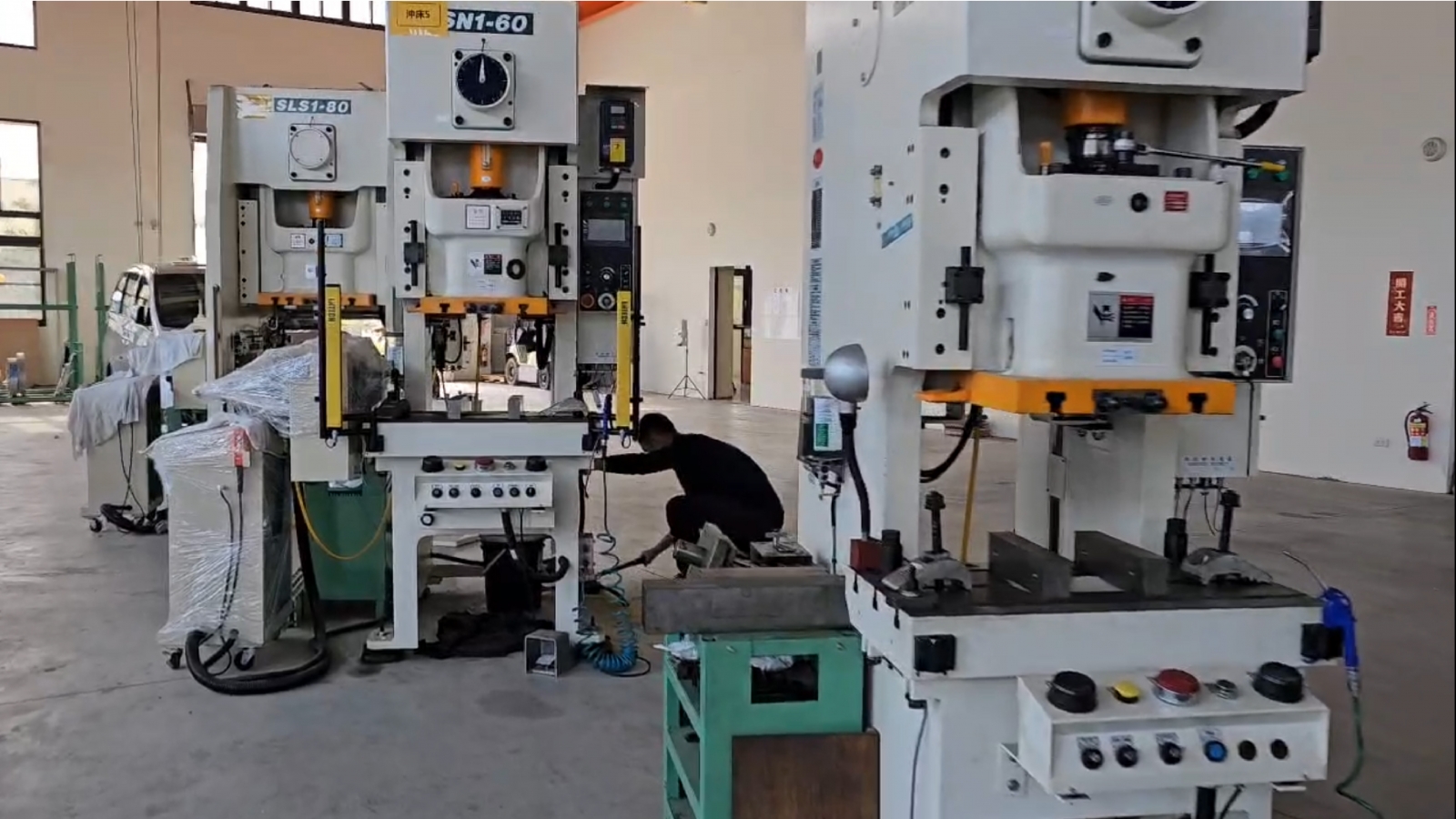
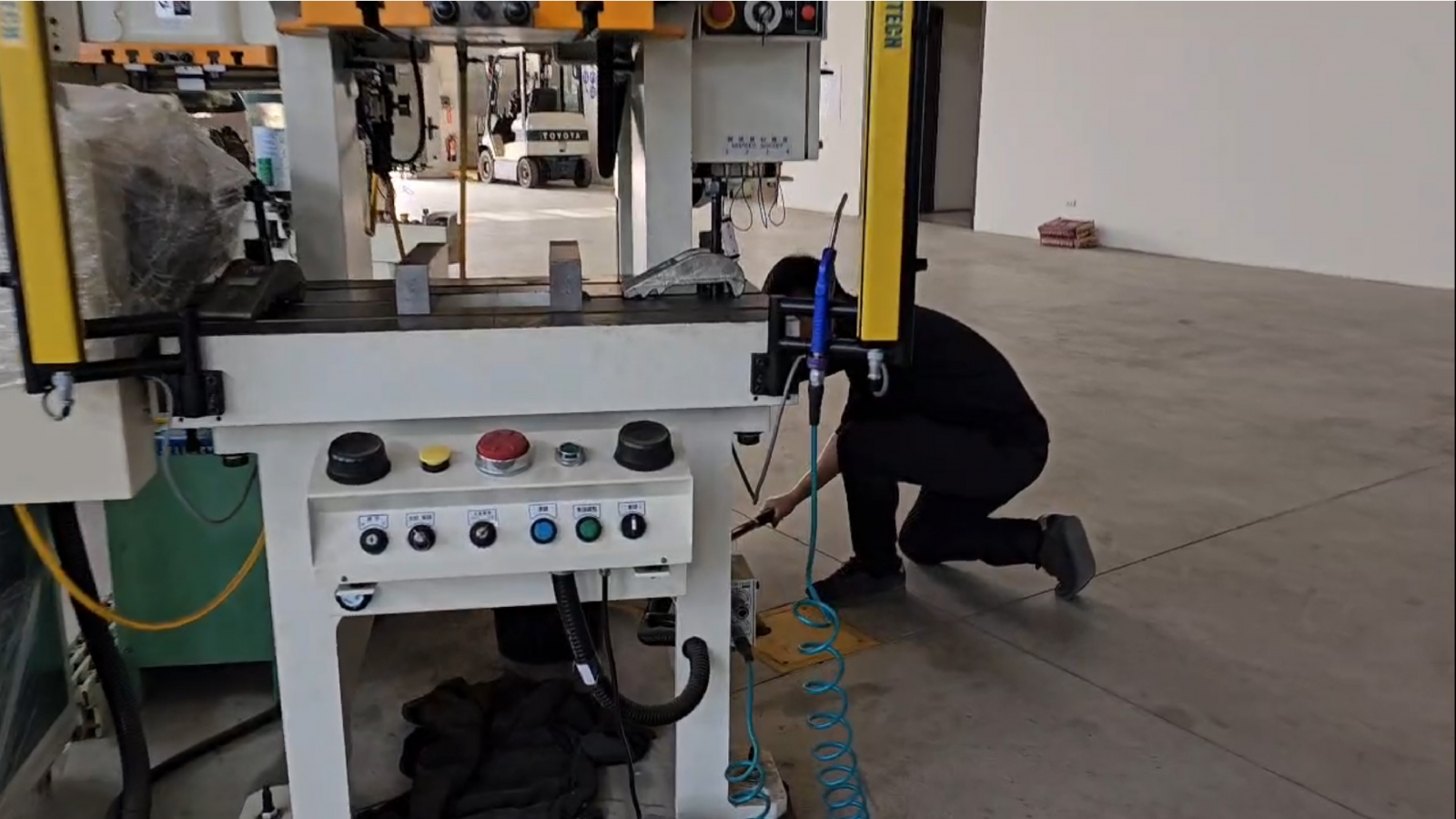
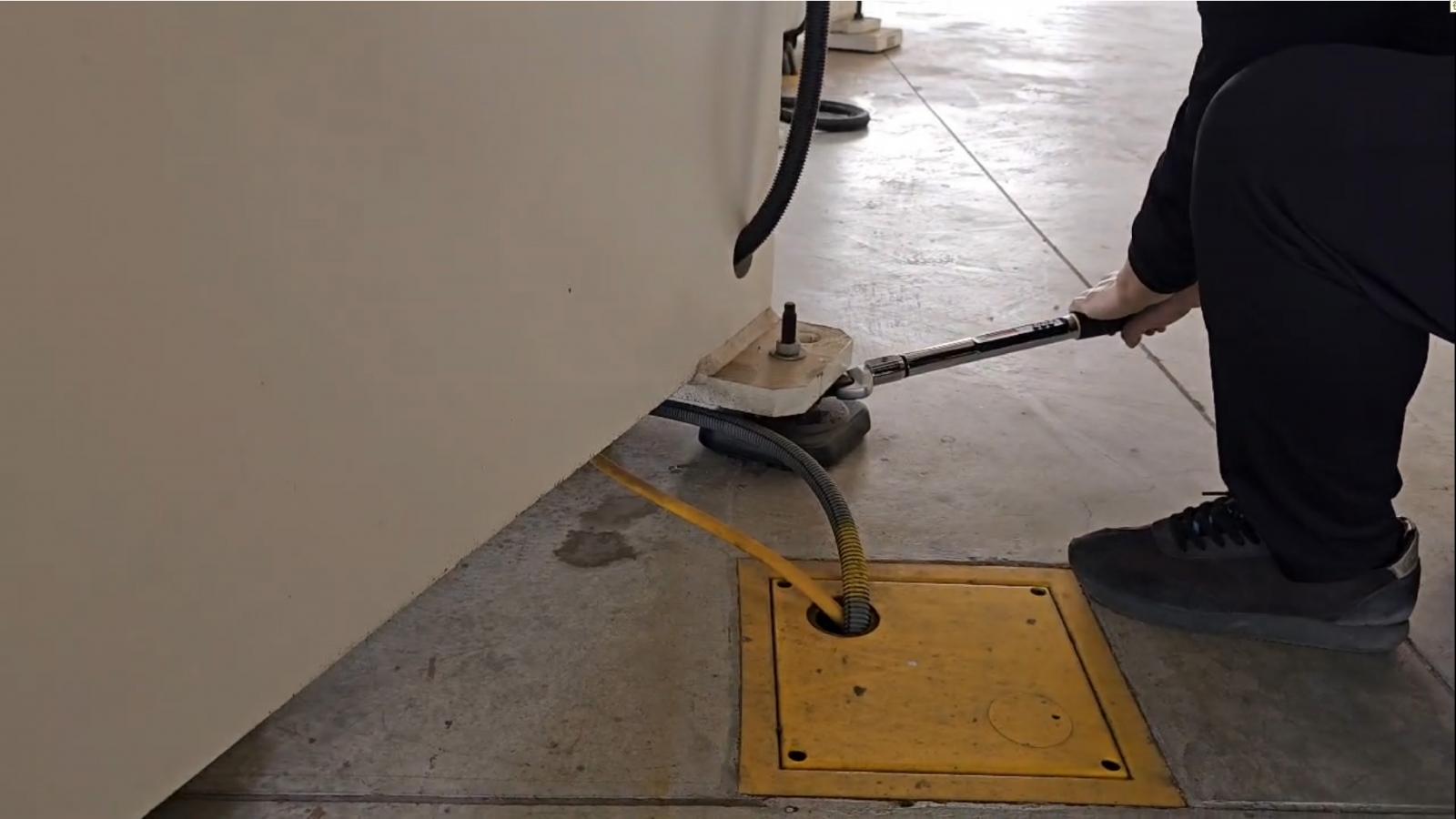
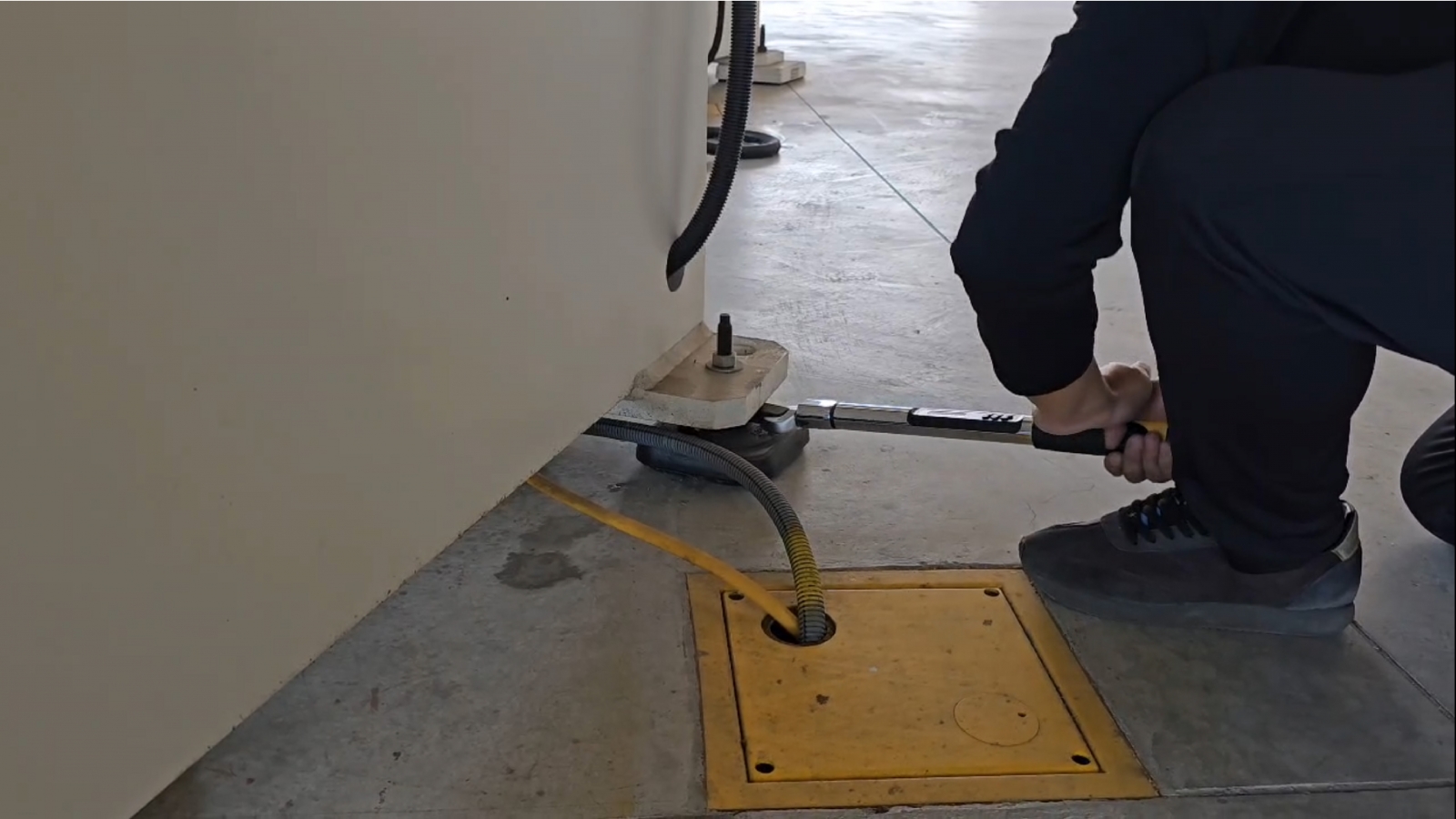
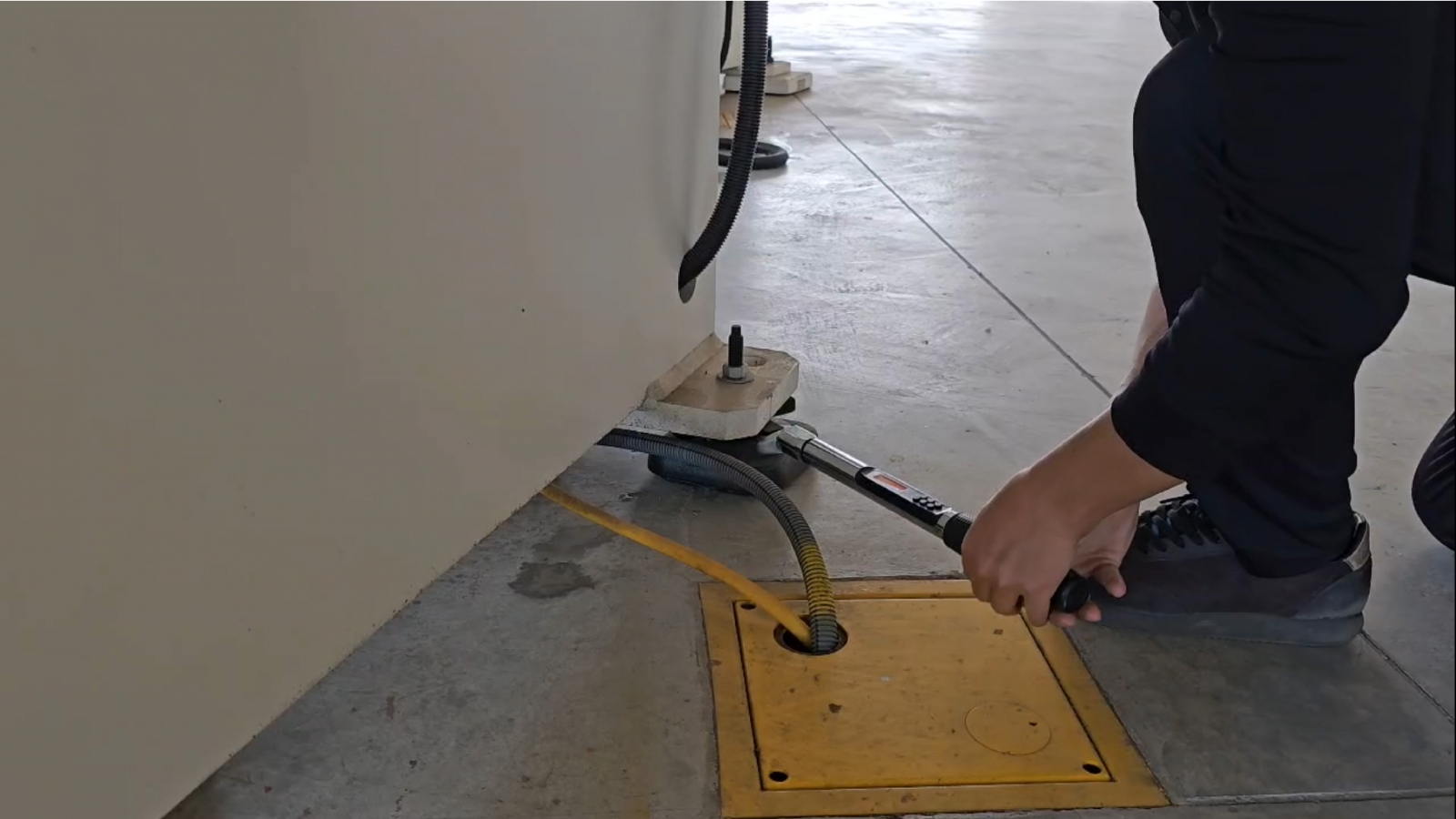
▲ Height adjustment under load with heavy-duty adjustable anti-vibration leveling feet
How to Install Leveling Feet on Heavy-Duty Equipment: Through Holes vs. Tapped Holes
Our sales team often receives feedback from engineers that heavy-duty leveling feet are not supporting the expected load. After investigation, we often find that the equipment mounting holes have been tapped, which changes how the leveling foot carries the load. When installing DK-07 / DK-09 heavy-duty adjustable leveling feet, be sure to follow the correct machining method:
- For equipment mounting holes, drill through holes only. Do not tap the holes.
- Why tapping is not recommended: If the equipment mounting hole is tapped, the equipment weight is transferred to the center threaded stud instead of being supported by the base plate. This prevents the leveling foot from taking advantage of its load-bearing design and can significantly reduce its intended load capacity and anti-vibration performance.
※ The through-hole diameter and leveling foot stem length affect the available articulation angle. Be sure to consider both dimensions during installation.

▲ Load distribution comparison: tapped hole vs. through hole
| Comparison | Tapped Hole | Through Hole |
|---|---|---|
| Load-Bearing Component | Threaded Stud | Body / Base Plate |
| Load Location | M16 threaded stud carries the load, reducing load capacity *Damage may occur when the load exceeds the allowable capacity |
M48 threaded stud carries the load, providing the specified load capacity |
[ 4 ] Articulating Leveling Feet: Load Capacity & Material Comparison
The following sections provide a detailed comparison of the load capacity and materials used in Asmith Articulating Leveling Feet.
Articulating Leveling Feet Load Capacity Comparison
Choosing the right series can be confusing, especially when comparing M12, M16, and M20 sizes. This table lets you compare the available options at a glance without opening each individual product page. To view load test images, click the load capacity corresponding to the model, or visit Asmith Leveling Feet Load Test Results.
| Thread Size | DK(S)-10 | DK(S)-08 | DK(S)-04 | DK(S)-05 | DK-09 | DK-07 |
|---|---|---|---|---|---|---|
| M8 | 130 kgf | 130 kgf | 100 kgf | — | — | — |
| M10 | 190 kgf | 190–250 kgf | 150 kgf | |||
| M12 | 390 kgf | 320–390 kgf | 400 kgf | |||
| M16 | 780 kgf | 520–840 kgf | 500–700 kgf | 700 kgf | 1,300 kgf | 1,700 kgf |
| M20 | 900 kgf | 900 kgf | 800 kgf | 800 kgf | — | — |
"—" indicates that the series is not available in that thread size. The DK(S)-05 series is available only in M16 and M20. If you need 15° articulation with floor anchoring in smaller M8–M12 sizes, there is currently no corresponding specification; DK(S)-04 may be considered as an alternative.
Material Comparison and Recommended Applications for Articulating Leveling Feet
Asmith Articulating Leveling Feet are available with different materials for the base plate and threaded stud:
| Material (Applicable Series) | Zinc-Plated SCM Steel (DK Series) |
SUS304 Stainless Steel (DS Series) |
PA66 + GF (DK(S)-04/05) |
FC-250 Cast Iron (DK-09/07) |
S45C Steel (DK-09/07 Threaded Stud) |
|---|---|---|---|---|---|
| Key Treatment | Zinc Plating for Corrosion Protection | None (Base Material Is Corrosion Resistant) | Glass-Fiber-Reinforced Plastic | Powder Coating | Quenching & Tempering + Phosphate Treatment |
| Mechanical Strength / Load Capacity | High | High | Medium | Very High | Very High |
| Corrosion Resistance | Medium | Excellent | Good (Electrically Insulating) | Good | Medium |
| Key Limitations & Recommended Environment | General industrial environments; ⚠️ Scratches may lead to rust; not recommended for acidic, alkaline, or highly humid environments |
Ideal for wet, washdown, acidic, and alkaline environments; wide operating temperature range |
Heat resistant up to 130°C, good chemical resistance; ⚠️ Not recommended for extremely dry environments (humidity <40% may cause embrittlement) |
High rigidity / excellent vibration damping / UL94 V0 flammability rating; ⚠️ Damage to the coating may lead to rust |
Heavy loads, high-frequency vibration, and high shear-force environments; ⚠️ Regular oiling is required for rust prevention |
Rubber Pad Material Comparison: Vibration Control & Durability
In addition to the metal and plastic components, the rubber used in the anti-vibration module is also critical to environmental performance:
NBR (Nitrile Rubber) (Used in DK(S)-08, DK(S)-04, and DK(S)-05):
Characteristics: Excellent oil resistance, including resistance to cutting oil and machine oil, as well as good wear resistance.
Limitations: Lower weather and ozone resistance. Not recommended for long-term exposure to intense sunlight or highly oxidative environments.
CR (Chloroprene Rubber / Synthetic Rubber) (Used in DK-09/07):
Characteristics: Excellent overall performance, with good oil resistance, weather resistance, flame resistance, and mechanical strength. It also provides effective vibration damping and is suitable for long-term load-bearing applications on heavy machinery.
Material Selection and Recommended Applications
For different operating conditions, consider the following recommendations:
- Hot and humid / acidic or alkaline / frequently washed equipment ⇨ Choose SUS304 first (DS-10, DS-08, DS-04, DS-05)
- Heavy loads / high vibration / compression resistance and vibration damping ⇨ Choose FC-250 or S45C (DK-09, DK-07)
- Electrical insulation / lightweight design / moderate loads ⇨ Choose PA66 + GF (DK-04, DK-05)
- General indoor industrial use / cost-conscious applications ⇨ Choose zinc-plated SCM steel (DK-10, DK-08)
Articulating Leveling Feet FAQ
Q1: What Are Articulating Leveling Feet?
A: Support components with an arc or ball-head structure at the bottom of the threaded stud. They can conform to uneven floor surfaces and help reduce uneven loading on the threaded stud.
Q2: What's the Difference Between Articulating Leveling Feet and Standard Adjustable Feet?
A: Standard adjustable feet, also known as machine feet or leveling feet, primarily provide height adjustment. Articulating Leveling Feet also provide angular compensation, allowing the foot to conform to the slope of the floor.
Q3: What Types of Equipment Need Articulating Leveling Feet?
A: Articulating Leveling Feet are suitable for equipment where level stability, vibration control, or positioning accuracy is important. Common applications include:
- Automation equipment (automated assembly machines, AOI systems, packaging and material handling equipment): Heavy equipment requires stable positioning
- Semiconductor equipment (wafer-processing equipment, inspection equipment, cleanroom equipment): High requirements for leveling accuracy and vibration control
- CNC machine tools (milling machines, lathes, machining centers): Vibration can directly affect machining accuracy and tool life
- Laser equipment (cutting machines, engraving machines): Heavy equipment requiring high positioning accuracy
- Metrology equipment (coordinate measuring machines, optical inspection equipment): Even small amounts of vibration can cause measurement errors
- Conveying equipment (conveyors, automated material handling equipment): Uneven floors can cause conveying misalignment
- Food, medical, and pharmaceutical equipment: SUS304 stainless steel Articulating Leveling Feet are commonly selected for corrosion resistance and ease of cleaning
Q4: Is a Higher Load Capacity Always Better?
A: No. Selection should be based on the total equipment weight, number of support points, and center-of-gravity distribution. Choosing an unnecessarily high load capacity increases cost and may increase the overall height, while choosing one that is too low can compromise stability.
Q5: Is the Recommended Load the Same as the Maximum Breaking Load?
A: No. The recommended load includes a safety factor. The actual breaking load is significantly higher than the values shown in the specification tables.
Q6: What's the Difference Between the DK and DS Series?
A: The main difference is material. DK uses zinc-plated SCM alloy steel, while DS uses SUS304 stainless steel for better corrosion resistance. The two series offer the same load capacity specifications.
Q7: How Do I Choose Between 4° and 15° Articulation?
A: For relatively level floors, 4° articulation is generally sufficient (DK(S)-10 / 08). If the floor has a significant slope or unevenness, choose 15° articulation (DK(S)-04 / 05).
Q8: When Should I Choose Articulating Anti-Vibration Leveling Feet with Rubber Pads (08/04/05)?
A: Choose these series when the equipment generates vibration or has a higher risk of movement. "Articulating Leveling Feet" is the general term, while Articulating Anti-Vibration Leveling Feet are equipped with an NBR rubber pad. If you only need basic leveling adjustment, the standard DK(S)-10 is sufficient.
Q9: Can Nylon Articulating Anti-Vibration Leveling Feet Be Used in Dry Rooms?
A: Not recommended, because the material may become brittle. DK(S)-04 / 05 series products are recommended for environments with 40–60% humidity, which covers most standard indoor environments. For dry rooms, choose the metal DK-10 or DK-08 series instead.
Q10: Why Can't Heavy-Duty Leveling Feet Be Installed Using Tapped Holes?
A: The DK-07 and DK-09 heavy-duty Articulating Leveling Feet use a specialized load-bearing structure in which the central M16 thread is not the primary load-bearing point. The equipment mounting hole should be a through hole so that the load is supported by the base plate. If the hole is tapped, the load path may shift, preventing the leveling foot from achieving its designed 1,300–1,700 kgf load capacity.
Q11: What's the Difference Between DK-07 and Standard Articulating Leveling Feet?
A: Standard Articulating Leveling Feet primarily use the structure at the bottom of the threaded stud to provide angular adjustment and are suitable for general equipment. DK-07 / DK-09 are designed for large machinery. Their base plate distributes the load and allows height adjustment while the equipment remains under a high load.
Specification data source: Asmith DK(S) Series Catalog. For actual product selection, consider the equipment's center-of-gravity distribution, dynamic loads, and installation environment, and always maintain an appropriate safety factor.
Editorial & Technical Review Team
Last updated: July 2026